 ®

Technical guide
WP vs NMRV Worm Gearboxes: How to Choose
Author: CHINFAR Technical Team · Reviewer: Tinyuen (CHINFAR) · Updated: 2026-11-04
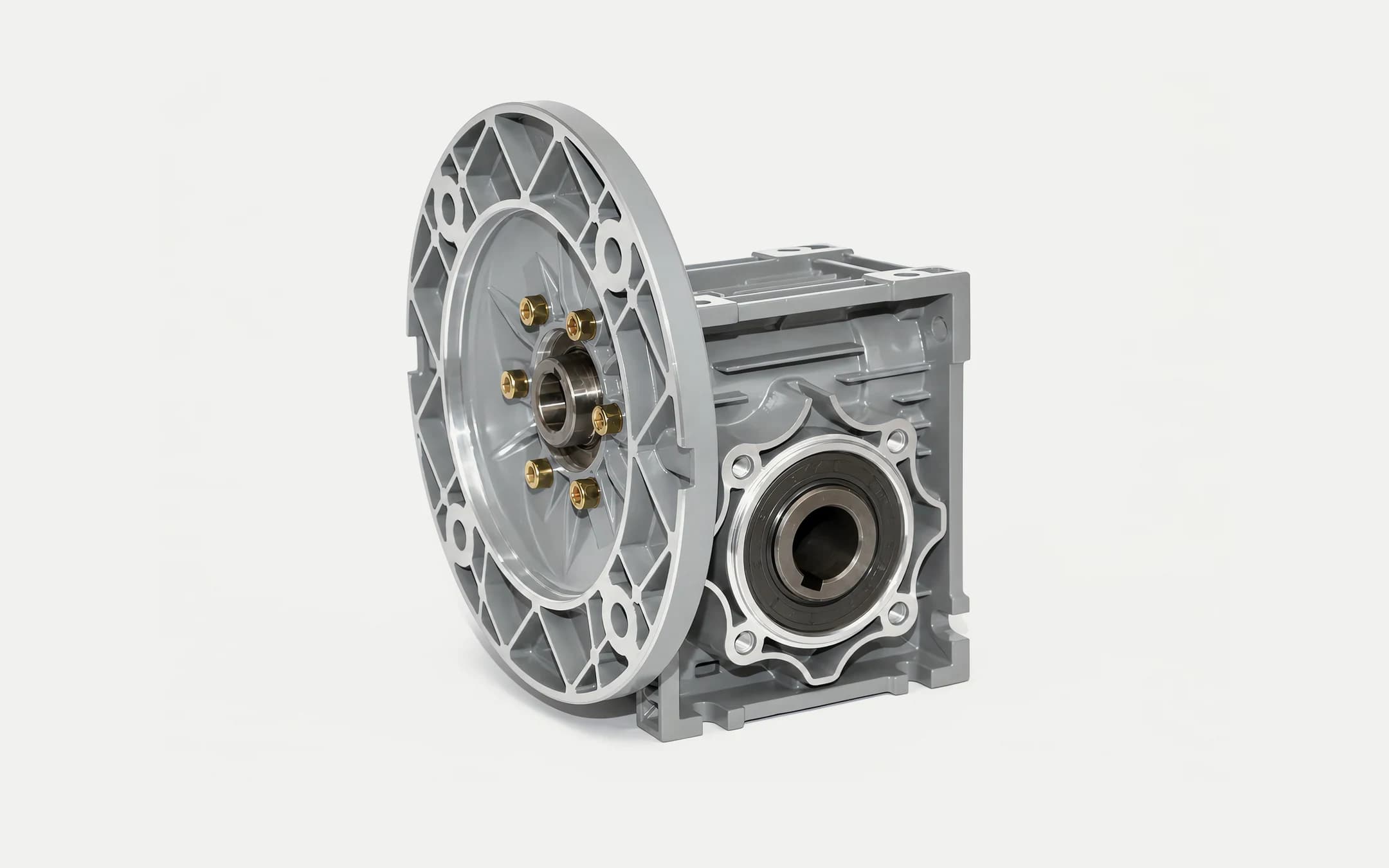
This is not a question of which one is better. The decision splits on three things: whether you are designing something new or replacing a unit already in service, how heavy the load is and how much shock it carries, and whether you need modular motor mounting or a compact footprint. The one-line memory aid: aluminium housing → NMRV, cast-iron housing → WP; light duty → NMRV, heavy duty → WP.
Those three split questions, spelled out:
- New design, or a unit already running? On a replacement, look first at whether the old housing is aluminium or cast iron — that alone nearly decides the destination.
- How heavy is the load, and how much shock comes with it? Heavy-duty, mining and heavy industrial drives route to the cast-iron WP series; light and medium duty, packaging, gates and small mixers route to the aluminium NMRV series.
- Modular motor mounting and a tight footprint — needed or not? Where compactness and modular builds matter, NMRV; where a straightforward layout, a mature specification and easy replacement matter, WP.
Where this sits after the category pre-screen
There is already a selection guide on this site, *How to select a worm gear reducer: NMRV, WP and CWU*. It does the product category pre-screen — one positioning sentence per series — and it states plainly that those descriptions serve only for the initial category screen and do not mean the three product categories are interchangeable in efficiency, load capacity or dimensions.
That statement is correct. It also means the comparison that should follow the pre-screen is not in that article.
This article is that missing step. CWU is out of scope here — it is a concave-tooth worm design and routes differently — so what follows is the WP against NMRV comparison only.
Three differences that actually decide it
| NMRV | WP | |
| Housing material | Aluminium | Cast iron |
| Load positioning | Compact and modular, light to medium duty | Heavy-duty design |
| Typical applications | Conveyor drives, small mixers, gate and flap drives, packaging equipment | Mining equipment, conveyor systems, heavy industrial drives |
| Replacement compatibility | SEW WF, Bonfiglioli VF, Rossi RV | SEW WF cast-iron series, Bonfiglioli W, Rossi WV |
| Environment | Corrosive sites need the coating checked | Usually more tolerant of dust and shock |
| Best fit | New designs and OEM builds | Mature specifications, replacements, heavy industrial builds |
The row that carries the most information is replacement compatibility — it maps the two series onto different variants of the same international brand families, and that mapping is exactly where the routing rule below comes from.
The environment row needs one boundary as well: the difference in housing material is only the starting point, and the outcome ultimately depends on the protection rating — how well the coating, surface treatment and sealing are done usually matters more than the material itself.
Replacing an imported unit? Route by housing material
This is the most useful part of this article.
When you are swapping out an imported worm gearbox, the first effective question is not "what torque do you need". It is: "was the old one aluminium or cast iron?"
Because the two series are positioned by housing material in the first place:
- Aluminium-housing family (Bonfiglioli VF, Rossi RV and similar) → NMRV;
- Cast-iron family (Bonfiglioli W, Rossi WV, SEW WF cast-iron series and similar) → WP.
The mapping is dependable because it comes from the dimensional compatibility the products are positioned on, not from guesswork. But dimensionally compatible is not the same as performance-equivalent, and neither is the same as a drop-in replacement. Three things have to be measured on the machine:
| What to measure | Why a measurement is unavoidable |
| Center distance | Worm gearboxes are sized by center distance; one step out and the unit either will not fit or the drive will not behave as expected |
| Mounting hole pattern | Hole spacing, hole diameter and flange register decide whether it lands on the existing base or mounting plate |
| Shaft end | Shaft diameter, key and shaft extension decide whether it couples to the driven part |
Quoting a model number without those three measurements is the most common way a replacement selection fails at the very start. One photo of the old nameplate plus one photo of the mounting position is worth more than ten model numbers.
The selection route, in four questions
Ask them in order and the field usually narrows to a single series:
Question 1: Replacement, or a new design?
  ├─ Replacement → look at the old housing: aluminium → NMRV; cast iron → WP   (then go to Question 3 for dimensions)
  └─ New design → continue to Question 2

Question 2: How heavy is the load, and how much shock?
  ├─ Heavy-duty, mining, obvious shock → WP
  └─ Light to medium duty, packaging, gates, small mixers → NMRV

Question 3: Is space tight, and do you need modular motor mounting?
  ├─ Compact, several input arrangements to choose from → NMRV
  └─ Straightforward layout, easy replacement → WP

Question 4: What is the environment?
  ├─ Heavy dust, shock → lean WP (cast iron usually tolerates it better)
  └─ Damp or corrosive → both need coating and protection taken seriously
Once all four are answered, one series is normally left. Take that series to its product page and check the specific specification there.
Note: this article lists no ratios, torques or frame sizes, because those are parameters that have to be checked against the actual configuration. See the corresponding product page, or ask directly.
Four things no catalogue can settle
A catalogue tells you the shape and the specification steps. These four have to be established on site, and any one of them answered vaguely can put you on the wrong series:
| Item to check | Why the catalogue cannot settle it | What it costs if you do not ask |
| Mounting orientation | Change the orientation and the oil level datum and the breather position move with it | Wrong oil level, an ineffective breather, seepage early in life |
| Heat dissipation | Ambient temperature, airflow and whether the space is enclosed are only known on site | Continuous running uses up the thermal margin |
| Starts, stops and reversing | Frequency and reversing duty set how much shock is really there | An NMRV chosen for light duty turns out to carry near heavy-duty shock |
| Additional load on the output shaft | Belts, sprockets and agitator shafts bring radial and axial forces | Bearings loaded beyond expectation, and early failure |
These are the same checks the existing selection guide sets out, and they are not re-explained here. They appear for one reason: they also move where the WP versus NMRV line falls.
Condition-by-condition judgment
| Site situation | Main risk | Data you still need | Where it points |
| Replacing an old imported unit | The model does not match and the unit will not fit | Old nameplate, center distance, hole pattern, shaft end | Route by housing first, then measure the three dimensions |
| Old unit is aluminium-housed but the load is on the heavy side | NMRV is tight on capacity | Actual load and shock | Re-check whether WP is the better route, and confirm the space available |
| Old unit is cast-iron-housed but space is very tight | WP occupies more room | Available installation space | Check whether a compact alternative exists |
| Mining, heavy industry, obvious shock | A light-duty model will not last | Shock type and frequency | WP |
| Packaging, gates, small mixers | Over-designed; cost and bulk wasted | Actual load | NMRV |
| Continuous running, poor ventilation | The thermal margin is used up | Ambient temperature, airflow, duty cycle | Re-check heat dissipation on both series |
| Damp or corrosive environment | Housing and coating degrade | Corrosive medium, humidity | Take surface treatment and protection seriously |
| Frequent reversing | Shock and backlash problems | Reversing frequency, whether reversing happens under load | Raise the load class in the assessment; see the braking and start-stop articles |
Field checklist
Before replacing a unit:
- Photograph the old nameplate and the mounting position as a whole.
- Measure the center distance, or verify it against the nameplate.
- Measure the mounting hole spacing, the hole diameter and the flange register.
- Measure the shaft diameter, the key and the shaft extension.
On a new design:
- Establish the load character: smooth, shock-loaded, or frequently reversing.
- Establish the mounting orientation, then check oil level and breathing against it.
- Establish the environment: temperature, dust, humidity, any corrosive medium.
After selection, check again:
- Check that the housing material of the chosen series matches what the environment needs.
- Check that the installation space actually takes the unit — a cast-iron housing normally needs more of it.
- Confirm the heat dissipation suits continuous running.
- Confirm that any additional load on the output shaft has been submitted and reviewed.
Common mistakes, and where this article stops
Common mistakes:
- Asking only "which is cheaper" or "which is better", and never asking about housing and load. Those two questions cannot produce a correct answer.
- On a replacement, quoting only a model number and not measuring center distance, hole pattern and shaft end.
- Treating "dimensionally compatible" as "drop-in replacement".
- Staying with a light-duty positioning on a heavy or shock-loaded duty.
- Changing the mounting orientation without re-checking the oil level and the breather.
- Working from the catalogue alone, with no question about heat dissipation and duty cycle.
- Overlooking the additional load that belts, sprockets and agitator shafts put on the output shaft.
Where this article stops:
- The comparison and the routing rules here apply to selecting between WP series and NMRV series worm gearboxes.
- This article lists no ratio, output torque, frame size, efficiency or temperature-rise values — those have to be read off the corresponding product page for the actual configuration, or confirmed by engineering.
- This article makes no price comparison. Cost depends on quantity, configuration and supply conditions.
- "Replacement compatibility" here means a correspondence at the level of external dimensions only; it does not mean performance equivalence and does not mean a drop-in replacement.
- This article does not replace the selection calculation and safety review for a specific machine.
Enquiry data sheet
| No. | Item | Note |
| 1 | Replacement or new design | Decides whether the housing route comes first |
| 2 | Old nameplate details | Required for a replacement; model and specification |
| 3 | Measured center distance | Required for a replacement |
| 4 | Mounting hole pattern and flange register | Required for a replacement |
| 5 | Shaft end and key dimensions | Required for a replacement |
| 6 | Load character and size | Smooth, shock-loaded, frequently reversing |
| 7 | Duty cycle and hours run per day | Continuous or intermittent |
| 8 | Mounting orientation | Drives oil level and breathing |
| 9 | Environmental conditions | Temperature, dust, humidity, corrosion |
| 10 | Additional load on the output shaft | Belts, sprockets, agitator shafts and similar |
Items 3, 4 and 5 are the core of any replacement case: without them, any model recommendation is only a guess.
About this article and the publisher
This article was written by the technical team of Chengfa Reducer (Changzhou) Co., Ltd. (CHINFAR) and published after the company's technical review. The NMRV and WP series worm gearboxes are supplied by Chengfa Reducer (Changzhou) Co., Ltd. CHINFAR products are produced and delivered on the joint manufacturing system shared with HUIGUANG.
Detailed specifications, and the category pre-screen this article follows on from, are on these pages and are not repeated here:
- WP series worm gearboxes
- NMRV series worm gearboxes
- How to select a worm gear reducer: NMRV, WP and CWU
Next step
Send the ten items above to sales@chinfar.com. If it is a replacement, attach the old nameplate photo and the mounting position photo as well — those two photos usually save two rounds of back-and-forth.
To be clear about what this article does: the comparison routes the decision. The specific specification, the ratio and the load capacity have to be checked against the configuration; dimensional compatibility is not performance equivalence; and before a unit is replaced, measure the three dimensions and have engineering review them.