 ®
Application note
How to select a gearbox for scraper conveyors in mining and ash handling
Author: HUIGUANG × CHENGFA Transmission Technical Team · Updated: 2026-10-11
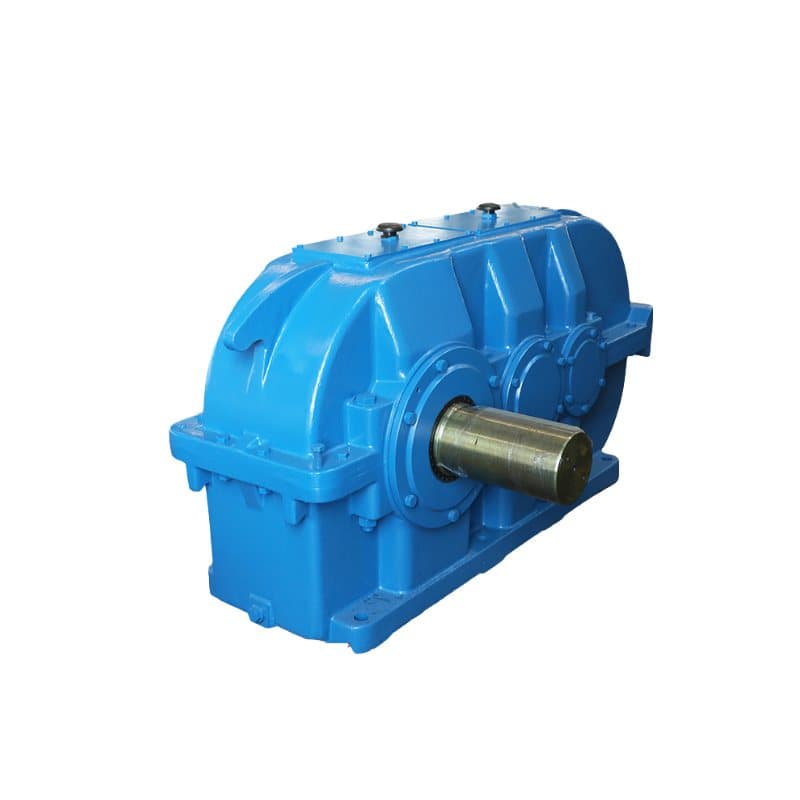
Scraper conveyors are the heavy-haul workhorses of underground coal, hard-rock mining, power-plant ash handling, and cement clinker transport. They move ore, coal, slag, fly ash, and clinker along an enclosed trough by chains fitted with flight bars that drag the material from one end to the other. The drive sees the cumulative resistance of every kilogram of material in the trough plus the chain and flight-bar weight, and that load profile is fundamentally different from a belt conveyor. For OEM equipment builders, system integrators, and overseas procurement engineers, the gearbox selection step is where the duty is converted into a frame size, a mounting arrangement, and a spare-parts plan.
Two conveyor-family facts drive the gearbox spec. First, the chain pull is set by the conveyor length, the chain mass per metre, the flight-bar profile, the material bulk density, the trough friction coefficient, and the inclination angle. Chain pulls of 25 to 200 kN per strand are normal on coal and ore scraper conveyors; larger machines reach 250 to 500 kN per strand. Second, the drive arrangement is rarely a single motor on the head shaft. Long scraper conveyors above 80 to 100 m run chain tensions that require intermediate drive stations at multiple positions along the conveyor; each drive station carries a fraction of the total pull, but the gearbox at each station still sees the full chain-pull on its downstream side. The gearbox selection must close both facts together — chain pull on the output side, motor torque on the input side — before the SF band is applied.
This application note uses the envelope 7.5 to 250 kW motor power, 12.5:1 to 80:1 ratio range, 25 to 500 kN chain pull per strand, and conveyor length 30 m to 600 m as the typical OEM band for coal, ore, slag, fly ash, and clinker scrapers. Outside this envelope the selection logic is the same but DCY right-angle industrial gearboxes, cycloidal units, or twin-pinion heavy-duty industrial units become the right answer; this is summarised in the closing enquiry checklist.
Scraper conveyor types and operating conditions
Three scraper-conveyor architectures dominate OEM enquiries. The horizontal or low-incline (0° to 15°) scraper is the most common, used in underground coal, in power-plant ash handling, and in cement clinker transport, with chain pulls of 25 to 200 kN per strand and motor power of 7.5 to 132 kW per drive station. The inclined scraper (15° to 30°) carries the same material uphill and raises the chain pull by 5 to 25 percent because of the gravity component. The en-masse or vertical scraper lifts material at 30° to 90°, typically with a slow chain speed and very high chain pull, and uses a totally enclosed casing. Across all three, the chain pitch is typically 100 to 250 mm, the flight-bar height is 80 to 300 mm, the trough width is 400 to 1200 mm, and the trough length can reach 600 m or more on long overland conveyors.
Underground coal and hard-rock mines add an explosion-protection requirement (ATEX / IECEx M2 for methane-exposed service, M1 for continuous mining-duty operation). Power plants and cement plants add high ambient temperature (up to 50 °C in summer) and high dust load (fly ash, clinker dust, limestone dust). Marine ports and stockyards add salt-spray exposure on conveyors that run from stockpile to ship-loader. The gearbox enclosure specification must follow the actual environment, not a generic indoor label, and the SF band must be raised one notch above the equivalent horizontal-conveyor band because of the higher shock load at chain pick-up and at tramp-iron events.
Chain pull, drive shaft torque, and service factor
Chain pull is calculated from the conveyor duty and material parameters: pull equals mass per metre times length times friction coefficient times safety factor, summed over the inclined portion. For a horizontal 80 m coal scraper with bulk density 0.85 t/m³, chain mass 25 kg/m, and friction coefficient 0.4, the steady-state chain pull is in the 30 to 50 kN range. The drive shaft torque is then chain pull times the sprocket pitch radius. For a 600 mm pitch-diameter sprocket on a single-strand conveyor that gives 4.5 to 7.5 kNm peak torque at full load, before the start-up and tramp-iron peaks are layered on.
Service factor (SF) on scraper conveyors runs higher than on belt conveyors because of the chain-pick-up peak, tramp-iron events, and chain-stretch dynamics. As a working rule for OEM selection on horizontal scraper conveyors: SF 1.5 for light-duty ash and limestone conveyors; SF 1.75 for steady coal and ore conveyors with limited start-stop; SF 2.0 for inclined coal scrapers above 15° and heavy-run slag or clinker conveyors; SF 2.5 for vertical en-masse conveyors and conveyors that handle tramp-iron-prone ore with regular stall events. Apply SF to the gearbox mechanical rating, not the motor nameplate, and check the rating against both thermal capacity (continuous duty on long conveyors) and peak torque (start-up and tramp-iron events). The full SF logic and how it changes the frame size is detailed in How Service Factor Affects Gearbox Selection; the input list at enquiry stage is in Industrial Gearbox Selection Inputs.
Single and twin-pinion drive arrangement
Single-pinion drive is the standard arrangement on scraper conveyors up to about 100 m length and 132 kW motor, with one drive station at the head shaft. The gearbox is shaft-mounted on the head shaft via a hollow-shaft with shrink disc, or mounted on a baseplate beside the head shaft with a coupling. Twin-pinion drive uses two gearboxes mounted side-by-side at the head shaft, each carrying half the total chain pull, with both motors sized to handle the full conveyor load alone so the second drive acts as a redundant overload margin. Twin-pinion is the standard on long overland scraper conveyors above 100 m, on heavy ore scrapers above 200 kN chain pull, and on conveyors where the OEM wants an instant overload margin. The two gearboxes must have ratios matched within 0.5 percent and the motors must be controlled as a paired VFD or soft-started in unison so the chain pull is shared evenly.
Intermediate drive stations run along long conveyors and split the chain tension into manageable sections. A 200 m conveyor might have one head drive plus two intermediate drives at 50 m and 100 m; each drive station has its own motor and gearbox, sized against the chain tension at that point. The gearboxes at the intermediate stations are typically smaller and lower-ratio than the head-station gearbox, but they all carry the same SF band because each is a critical node in the chain system. Synchronisation between drives is normally electronic (VFD pairing) rather than mechanical (line-shaft), because the chain itself absorbs any small mismatch in chain speed between drives.
Low-speed high-torque duty and cycloidal options
Scraper conveyors are slow-speed, high-torque machines. Output speeds of 8 to 30 rpm are typical, motor powers of 7.5 to 250 kW, and output torques of 1.0 to 30 kNm per drive station. The modular R/F/K/S geared-motor range covers the lower-power end (up to about 30 kW) and the lower ratios (under 30:1); above this, the right answer is a low-speed high-torque industrial gearbox in the HB, DCY, or cycloidal family. DCY right-angle gear units are the standard on heavy inclined scrapers because the right-angle layout fits the head-station geometry and the DCY range covers 22 to 250 kW with ratios up to 80:1. HB industrial units are the inline alternative where the head-station layout is inline rather than right-angle; they cover 22 to 630 kW with ratios up to 100:1 across two stages.
Cycloidal units become the right answer when the conveyor output speed drops below 8 rpm and the output torque exceeds the mechanical rating of the geared-motor range. Cycloidal single-stage ratios of 30:1 to 90:1 give a very compact head-station package with very high shock-load tolerance. The trade-off is a 5 to 10 percent efficiency loss compared with helical-bevel, which means a slightly larger motor and a slightly larger cooling requirement. For long conveyors with peak chain tensions at start-up and tramp-iron events, the cycloidal shock tolerance often justifies the efficiency loss. The geometry of cycloidal units is detailed in Cycloidal vs R-Series Helical Reducer; the application logic for low-speed heavy-duty conveyors is that cycloidal becomes the first choice at output speeds below 8 rpm with peak torque above 15 kNm.
Underground / wet / corrosive environment
Scraper conveyors in underground coal and metal mines operate in dust-laden, water-spray, and methane-exposed environments. ATEX / IECEx certification to Group I, Category M2 or M1 is mandatory on the motor and, for fully certified conveyors, on the gearbox enclosure too. The gearbox enclosure for underground duty is typically IP65 with a sealed terminal box on the motor, desiccant breather plug, dust lip-seals on both input and output shafts, magnetic drain plugs with sealed washers, and a continuous-gasket inspection cover. The surface coating system is two-part epoxy primer plus polyurethane or polysiloxane top coat, total dry-film thickness 200 to 280 µm. The breaker-and-coupler chain through the gearbox can be de-rated in methane-exposed service because of the temperature-rise limit; the gearbox is usually supplied with a flameproof (Ex d) terminal box for the motor and a non-sparking enclosure on the gearbox itself.
Wet and corrosive environments add material-grade requirements. For washdown service in food-grade or chemical plants, the gearbox housing is supplied with stainless or zinc-plated fasteners, a stainless nameplate, a polyurethane top coat rated for the chemical exposure, and food-grade synthetic lubricant. For marine or salt-spray service on port and stockyard conveyors, the standard ISO 12944 C5-M coating system is required. For cement and fertilizer plants, the breather plug is upgraded to a desiccant type, the oil seals are upgraded to FKM at temperatures above 60 °C gearbox temperature, and the inspection cover is sealed with a continuous gasket. The full surface protection rules across these environments are detailed in Industrial Gearbox Installation, Lubrication and First-Run Checklist.
Backstop and overload protection
Inclined scraper conveyors above 15° require a backstop to hold the loaded chain when the drive is de-energised. The standard arrangement is a sprag-type non-contact backstop integrated into the gearbox output, selected for the full output torque with the same SF as the gearbox, and confirmed to allow back-driving by an inching motor for maintenance without damage. Twin-pinion drives require one backstop per gearbox or a single combined backstop on the chain system; the combined arrangement is more reliable because it cannot back-drive through a single gearbox fault. A ratchet backstop is acceptable on light-duty conveyors below 30 kW but is not preferred on heavy-duty twin-pinion drives.
Overload protection on the input side comes from a fluid coupling, a torque-limiting coupling, or a shear-pin hub. The fluid coupling reduces the gearbox start-up torque to about 1.5 to 2.0 times the running torque and protects the gearbox from belt-stall events, at the cost of a 5 to 15 percent running slip that raises motor power draw and adds a heat dissipation requirement. The torque-limiting coupling sets a calibrated maximum torque and disconnects the motor from the gearbox on a chain-stall event; it requires re-engagement after each event. The shear-pin hub is the simplest protection and is reserved for light-duty conveyors below 30 kW. Electronic overload protection on the VFD or soft-starter is the standard on modern scraper-conveyor installations because it can be set tightly without nuisance trips, gives a fault signal back to the PLC, and avoids the running losses of a fluid coupling. The full protection logic across conveyor families is in How Service Factor Affects Gearbox Selection.
OEM enclosure and customization notes
OEM customers building scraper conveyors typically need more than a catalogue gearbox. Common customisations are: a non-standard output shaft bore or shrink-disc fit for a specific sprocket shaft diameter; an integrated sprag backstop with documented holding torque; an integrated hydraulic disc brake or brake-mounting flange for an external brake; a non-standard mounting position outside the standard M1 to M6 set; a special low-speed ratio for very long conveyors; an OEM-specific paint colour, label, and serial-number plate; an ATEX / IECEx certification dossier for underground service; and a documentation package including the test certificate, installation drawing, lubrication schedule, and spare-parts list.
Surface protection for mining scrapers is a standard requirement. The coating system is a zinc-rich primer at 60 to 80 µm, an epoxy intermediate coat at 100 to 150 µm, and a polyurethane top coat at 40 to 60 µm; total dry-film thickness 200 to 280 µm. For tropical or marine service the polyurethane top coat is replaced by a polysiloxane or fluoropolymer; for underground service the top coat is replaced by an anti-static finish rated for Group I explosion protection. The breather plug is sealed, the oil-level and drain plugs are magnetic with sealed washers, and the inspection cover is sealed with a continuous gasket. Export packaging is a fumigated wooden crate with VCI film and desiccant bags for ocean freight.
Documentation for OEM scraper-conveyor deliveries typically includes CE / ISO 9001 / EAC declarations depending on the destination, ATEX / IECEx conformity dossiers for underground service, test certificates, material certificates, dimensional inspection reports, installation drawings, lubrication schedules, and spare-parts lists. The OE enquiry should specify the destination country, the ATEX / IECEx zone (if applicable), the operating hours per shift, and the spare-parts philosophy the OEM wants to support. The detailed enquiry list is given in Industrial Gearbox Selection Inputs.
Enquiry checklist for scraper conveyors
For a clean quotation, send the following items to sales@chinfar.com. (1) Conveyor type — horizontal scraper, inclined scraper, en-masse vertical, twin-pinion heavy-duty, or intermediate drive. (2) Trough length, trough width, trough height, inclination angle. (3) Chain type, chain pitch, chain mass per metre, flight-bar profile. (4) Material handled and bulk density in t/m³. (5) Calculated chain pull per strand in kN and calculated drive shaft torque in kNm. (6) Motor power per drive station, motor speed, motor frame (IEC or NEMA) and supply voltage / frequency. (7) Number of drive stations, position along the trough, and rated chain pull at each station. (8) Output speed, output torque, ratio range. (9) Service factor applied by the OEM, or confirmation that the standard 1.5 to 2.5 scraper range is acceptable. (10) Output-side interface — hollow-shaft with shrink disc, keyed hollow-shaft, solid-shaft with coupling. (11) Soft-start type — direct-on-line, fluid coupling, electronic soft-starter, VFD, or wound-rotor slip-ring. (12) Brake and backstop requirements — none, integrated sprag, hydraulic disc brake, or combined. (13) Operating hours per day, ambient temperature, dust level, water or chemical exposure, ATEX / IECEx zone if applicable. (14) Surface protection, OEM colour and label, destination country for certification.
Send layout drawings of the drive station and sprocket arrangement when available; one sketch with motor centre height, gearbox mounting position, output shaft arrangement, sprocket shaft diameter, and brake / backstop interface saves at least one round of gearbox selection. For replacement projects, provide the original drawing or mounting dimensions and the existing motor and coupling arrangement.
Scraper-conveyor drive selection is a routine OEM exercise once the chain pull, the SF band, and the drive arrangement are all clear. The HUIGUANG × CHENGFA joint-manufactured modular R/F/K/S geared-motor range covers the 7.5 to 30 kW light-duty envelope; the HB industrial and DCY right-angle industrial lines cover the 22 to 630 kW heavy-duty envelope for ore, coal, and clinker scrapers; the cycloidal line supports very-low-speed high-torque conveyors below 8 rpm with peak torque above 15 kNm. The HUIGUANG × CHENGFA Transmission joint brand supports OEM equipment makers, system integrators and overseas procurement engineers on scraper-conveyor drives for underground mining, mineral processing, power-plant ash handling, and bulk-material-handling equipment worldwide, with engineering documentation, OEM labeling, surface protection, ATEX / IECEx certification, and export packaging arranged as part of the standard enquiry process.