 ®
Application note
How to select a gearbox for bucket elevators in cement, fertilizer and grain
Author: HUIGUANG × CHENGFA Transmission Technical Team · Updated: 2026-10-10
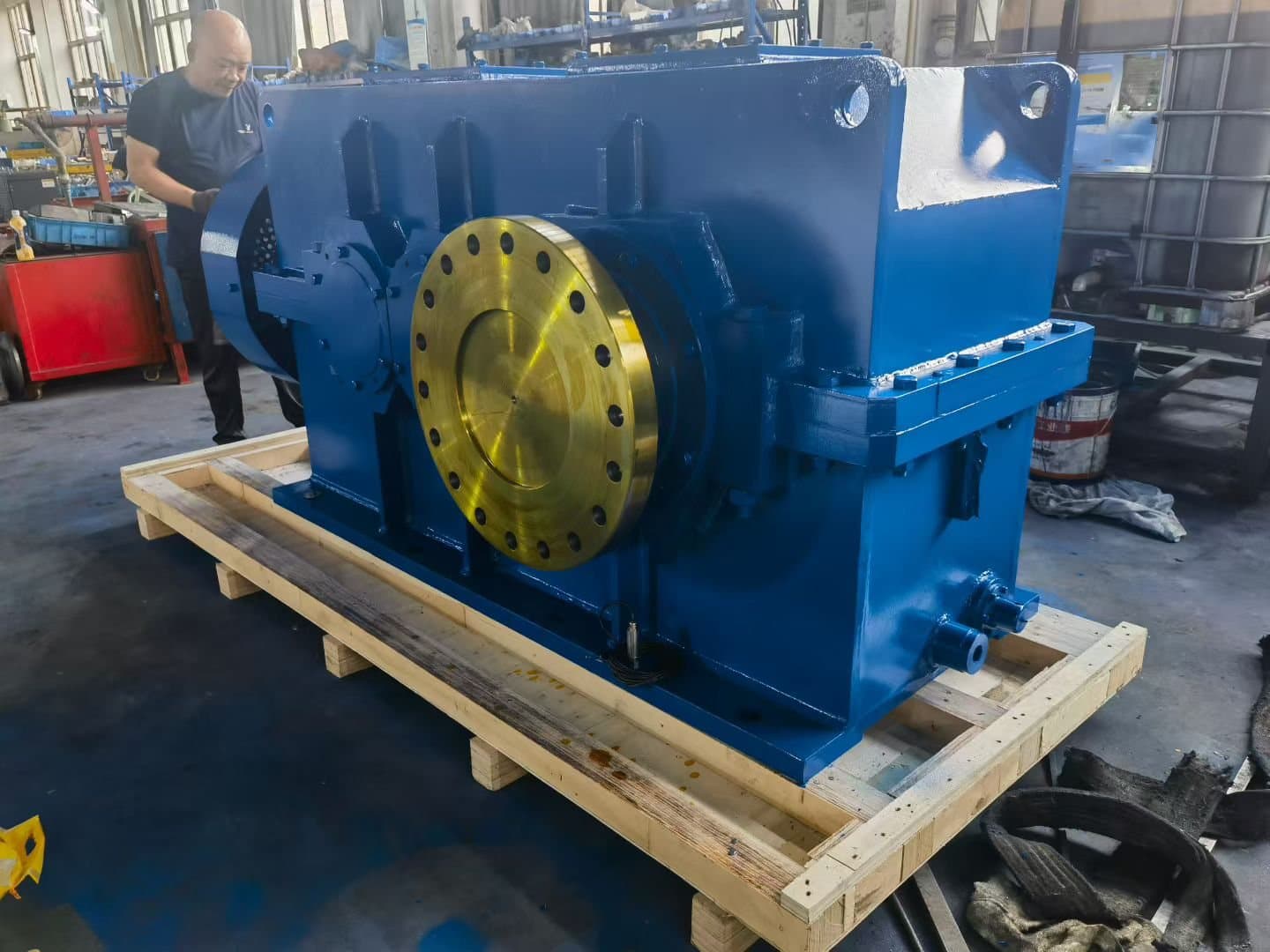
Bucket elevators are not standard conveyor applications. A bucket elevator lifts bulk material vertically on a belt or chain fitted with discrete buckets, and the drive sees a duty profile that is genuinely different from anything on a horizontal belt or a screw conveyor. The motor and gearbox sit at the head pulley, the belt runs around a boot pulley at the bottom of the leg, and between them the only load is the column of buckets and material returning on the gravity side. That geometry produces four conditions that the gearbox specifier cannot ignore: high starting torque when the belt is fully loaded after a stop, a controlled hold requirement when the drive is de-energised, reverse-rotation protection because any belt rollback under load can wreck the drive in seconds, and constant exposure to dust from the product being lifted. For OEM equipment builders and system integrators building cement, fertilizer, grain, feed, or mineral elevators, these four conditions set the gearbox selection — and they are also the reason CHENGFA treats bucket elevators as a dedicated application family rather than as a variant of horizontal conveying.
Bucket elevator types and operating conditions
There are three main bucket-elevator styles on the market, and the drive selection depends on which one the OEM is building. Centrifugal discharge elevators run the belt fastest (typically 1.0–2.5 m/s) and use shallow buckets; the material is thrown out of the bucket by centrifugal force as it passes the head pulley. They are the most common style for grain, feed, light aggregate, and finished-cement handling, and the drive sees relatively light starting torque but very high cyclic load on the buckets themselves. Positive-discharge elevators run the belt slower (around 0.5–1.0 m/s) with deeper buckets and a guide sleeve at the head pulley, so material is positively extracted rather than thrown out. They handle heavier, more abrasive products — clinker, slag, alumina, coarse ore — and the drive sees much heavier starting torque because the buckets are always fully loaded. Continuous-flow elevators use overlapping buckets on a chain at very low speed (0.3–0.8 m/s) and carry the product around the head sprocket without throwing it; they are used for fragile or friable material such as pellets, meals, and food-grade powders, and the drive runs almost continuously at full torque. Across all three styles, the head pulley diameter typically falls in the Ø200–Ø800 mm range, bucket spacing is 250–500 mm, and the motor power band for a single leg is roughly 3 kW for a small grain leg up to 90 kW for a heavy mineral or cement clinker leg. CHENGFA engineering practice is to specify the gearbox first on the type of discharge, then on the belt pull and shaft speed — not the other way round.
Torque and service factor for vertical lifting
Vertical lifting concentrates load on the head shaft. Every kilogram of product in the up-leg is supported by the belt, the buckets, and the head pulley bearings, and the gearbox has to deliver enough torque to start that column from standstill and keep it moving at the design speed under worst-case loading. The torque calculation follows standard belt-pulley practice — pull × pulley radius / efficiency — but the service factor is what protects the gearbox from real-world overloading, and for bucket elevators it is rarely below 1.5. For centrifugal discharge elevators with a steady, well-regulated feed, a service factor of 1.5–1.75 is normal. Positive-discharge and continuous-flow elevators with heavy or variable loading, frequent start-stops, or oversized buckets typically require 2.0–2.5. Any application that involves a shock load — such as a crusher-fed elevator, a reclaim elevator under a stockpile, or a bucket elevator feeding a packer — should be specified at 2.5 or higher, and CHENGFA applies that as a baseline whenever the OEM cannot guarantee a controlled feed. The wider rule is the same one used elsewhere in CHENGFA selection notes: service factor accounts for the difference between nameplate and reality, and a gearbox undersized on SF is a gearbox that fails in year two rather than year ten. For background on how SF interacts with thermal rating and duty cycle, see the engineering note "How Service Factor Affects Gearbox Selection".
Right-angle drives for head pulley and boot pulley
The vast majority of bucket elevators use a right-angle drive at the head pulley. The motor is mounted horizontally on the elevator leg casing, and the gearbox output shaft goes up vertically into the head pulley shaft. A helical-bevel (K-series) unit is the natural fit: a horizontal input shaft, a vertical output shaft, and a ratio range of roughly 20:1 to 60:1 covers most bucket-elevator duties. The bevel stage handles the direction change with low loss, and the helical pinion provides the reduction. Mounting is usually B5 flange or B14 small-flange to a fabricated pedestal on the head section, with the output shaft going up (shaft-up). On smaller centrifugal elevators where the motor and gearbox sit inside a compact head section, a shaft-down right-angle drive is sometimes used so that the gearbox sits under the pulley and the boot-pulley casing can be made shallower. For boot-pulley drives on chain elevators or where the OEM routes the motor at the bottom of the leg, a right-angle helical-bevel unit is again the standard answer, but the output orientation is horizontal driving into the boot shaft via a coupling or a sprocket. Within the HUIGUANG × CHENGFA product family, the K-series is the default head-pulley gearbox for centrifugal and positive-discharge elevators, and the H/B-series industrial range covers larger units where higher torque capacity is required. Background on the difference between inline helical, helical-bevel, and other families is in the engineering note "R, F, K and S Series Geared Motor Differences".
Vertical-output and through-shaft configurations
Not every elevator drive is a right-angle. Continuous-flow chain elevators and certain high-capacity positive-discharge designs sometimes drive the head shaft through an inline arrangement — either an H/B-series industrial gearbox with a vertical hollow output, or a vertical-shaft cycloidal unit. A vertical-output H/B unit is essentially an in-line helical reducer mounted with its output shaft pointing up; it has the advantage of a coaxial layout that aligns naturally with the head shaft, and it accepts a hollow-bore shrink-disc or keyed-shaft mounting directly on the pulley shaft. The cycloidal alternative is a vertical-output cycloidal reducer mounted up-down on the head shaft; these are popular where the OEM wants high shock-load capacity, very high single-stage reduction (often 30:1 to 90:1 in one stage), and a compact head section. Through-shaft arrangements — where a solid input shaft passes through the gearbox and is supported on both sides — are occasionally used when the drive is mounted as a side-by-side unit on the elevator leg, but most OEMs prefer a flange-mounted unit because it keeps the head section smaller and the shaft alignment simpler. Mounting position is specified as M1 to M6 per industry convention; CHENGFA always confirms the mounting position on the enquiry sheet because it determines the oil-fill level, breather location, and drain plug orientation. Reference: "Industrial Gearbox Mounting Positions M1 to M6".
Backstop, brake, and overload protection
The four backstop and brake configurations seen on bucket elevators, in increasing order of robustness, are: a ratchet backstop on the gearbox output shaft only, a sprag-type backstop integrated into the gearbox, a backstop plus an AC fail-safe brake on the motor, and a backstop plus a hydraulic or DC shunt brake with a separate brake-pad caliper on the head shaft. The first is acceptable only on light-duty centrifugal elevators with low belt load. The second is the most common in OEM-built equipment, because a sprag backstop is compact, fits inside the gearbox housing, and prevents reverse rotation the moment the motor torque drops to zero. The third and fourth are mandatory for any elevator that holds a heavy column of material — every positive-discharge or continuous-flow leg, and any centrifugal leg where the column of buckets plus material exceeds roughly 1.5 tonnes. For these drives CHENGFA engineering practice is to specify an integrated sprag backstop as standard and offer the AC fail-safe brake as the default brake option, with a hydraulic caliper brake or DC shunt brake as the upgrade choice for very heavy or safety-critical legs. Brake-pad material is usually a non-asbestos organic compound for general-purpose elevators, or a sintered metallic pad for cement and mineral elevators where the brake sees high energy per stop. Overload protection is supplied by a shear-pin hub, a torque-limiting coupling, or an electronic overload relay on the VFD; CHENGFA always recommends an electronic overload relay on any inverter-driven leg because it can be set tightly without nuisance trips and gives a fault signal back to the PLC.
Cycloidal vs helical-bevel for bucket elevators
For low-speed, high-torque bucket drives — typically continuous-flow elevators, heavy positive-discharge elevators, and any leg that drives through a chain rather than a belt — the choice between a cycloidal reducer and a right-angle helical-bevel unit is real. The cycloidal option offers higher single-stage reduction (often 30:1 to 90:1 in one box), very high shock-load tolerance because of its multi-tooth contact design, and a compact head section that suits vertical-output mounting on the head shaft. The trade-off is a lower mechanical efficiency (typically 0.85–0.90 per stage) and a more specialised spare-parts profile. The helical-bevel option offers higher efficiency (0.94–0.97 per stage), a broader ratio range without stage changes, and a more familiar spare-parts profile in markets where the OEM has a global service network. For most OEM applications the helical-bevel unit remains the first recommendation, with the cycloidal unit reserved for slow-speed chain elevators, heavy shock-load legs, and any application where the compact head section is a packaging constraint. A detailed side-by-side comparison is in the engineering note "Cycloidal vs R-Series Helical Reducer", but the short rule for bucket elevators is: belt-driven centrifugal and positive-discharge, use helical-bevel; chain-driven continuous-flow with heavy shock load, use cycloidal vertical. For small grain/feed elevators and low-power legs (typically under 5.5 kW) the NMRV worm-gear range is sometimes used as a backup option where cost is the primary driver; CHENGFA does not recommend it for any leg above 7.5 kW because of the efficiency loss on a continuously loaded drive.
ATEX / dust environment and surface protection
Bucket elevators are dusty by definition. Cement, grain, fertilizer, mineral, and feed plants all generate dust at the boot and the head, and a gearbox that is not protected will fail prematurely because dust contaminates the oil, attacks the seals, and fouls the breather. For non-ATEX plants the protection is straightforward: a heavy-duty radial shaft seal at the output (double-lip or taconite type), a shielded or filtered breather plug rather than an open one, and a primer-plus-topcoat finish on the housing in a colour specified by the OEM. For ATEX-classified plants — Zone 21 inside the elevator casing, Zone 22 around the head section — the requirements are stricter: the gearbox itself is usually a Category 3D unit (non-electrical dust ignition protection by enclosure), the breather must be a dust-rated sintered bronze or similar filtered type, oil seals must be dust-grade, and the surface finish must avoid any non-conductive coating that could accumulate static. CHENGFA standard practice is to supply every bucket-elevator gearbox with double-lip output seals, a filtered breather, and an OEM-specified RAL colour in a marine-grade or C4-grade coating system; ATEX-rated units are supplied against a documented conformity dossier including the nameplate marking, the operating-temperature range, and the dust-group compatibility.
OEM enclosure and customization notes
OEM customers building bucket elevators usually need more than a catalogue gearbox. Typical customisations are: a non-standard input flange to match a particular IEC or NEMA motor frame, a non-standard output shaft diameter or length to match the head-pulley hub, a hollow-bore output with a shrink-disc for direct pulley mounting, an integrated backstop with a documented holding torque, an integrated brake or a brake-mounting flange for an external brake, a special mounting position outside the standard M1–M6 set, a special oil-fill configuration for low-ambient or high-ambient operation, and a nameplate in the OEM's part number rather than the CHENGFA part number. OEM label, packaging, and documentation are also part of the scope: CHENGFA routinely supplies the gearbox with the OEM's part number on the nameplate, an OEM-branded serial-plate for traceability, a multi-language operating manual, and export-grade packaging in a fumigated wooden crate with a moisture barrier and a desiccant bag. Lead-time impact for the most common customisations is short — non-standard input flanges, special paint, and OEM nameplates are typically added without affecting the standard production lead time. Non-standard ratios or fully engineered specials add 2–4 weeks and should be flagged at the enquiry stage. Reference: "Industrial Gearbox Selection Inputs".
Enquiry checklist for bucket elevators
To get a fast and accurate quotation from CHENGFA for a bucket-elevator gearbox, the enquiry should cover at least the following ten points. (1) Elevator type — centrifugal, positive-discharge, or continuous-flow. (2) Belt or chain, and the head pulley or sprocket pitch diameter and rpm. (3) Bucket spacing, bucket weight empty, and material bulk density. (4) Required lifting capacity in tonnes per hour. (5) Motor power, speed, and supply (50/60 Hz, IEC or NEMA frame). (6) Required ratio and output torque at the head shaft. (7) Mounting position — M1 to M6, or a non-standard orientation with a sketch. (8) Backstop and brake requirements — none, integrated sprag, AC fail-safe, DC shunt, or hydraulic caliper. (9) Ambient conditions — temperature range, dust environment, ATEX zone if applicable, indoor or outdoor, any wash-down or chemical exposure. (10) Surface protection, nameplate, packaging, and documentation requirements. Submitting these ten points at the enquiry stage lets CHENGFA return a fully priced and technically validated offer on the first round, including the right primary recommendation (K-series helical-bevel, H/B-series industrial, or vertical-output cycloidal), the right backup option (R-series inline helical or NMRV for low-power legs), and any OEM customisations priced separately. CHENGFA technical support is available to review a proposed selection against the elevator design before the OEM commits to serial production.
HUIGUANG × CHENGFA joint manufacturing supports OEM equipment builders, system integrators, and overseas procurement engineers across vertical-lift bulk-material-handling equipment — bucket elevators, vertical conveyors, reclaim systems, and en-masse conveyors — with a complete range of heavy-duty industrial gearbox, helical-bevel, cycloidal, modular geared motor, and non-standard drive solutions. Whether the application is a small centrifugal grain leg or a heavy clinker elevator with ATEX-rated controls, CHENGFA engineering practice is to specify the gearbox on duty, service factor, and brake/backstop function first, and then size the catalogue unit against ratio, torque, and mounting position. For OEM enquiries, quotation support, or selection review on a specific bucket-elevator application, contact the HUIGUANG × CHENGFA technical team with the ten-point enquiry sheet above and the elevator line drawing; a fully validated selection and commercial offer typically returns within two working days.