 ®
®Technical guide
Gearbox Overheating: How to Read the Symptom and Find the Cause
Author: HUIGUANG × CHENGFA Transmission Technical Team · Updated: 2026-09-11
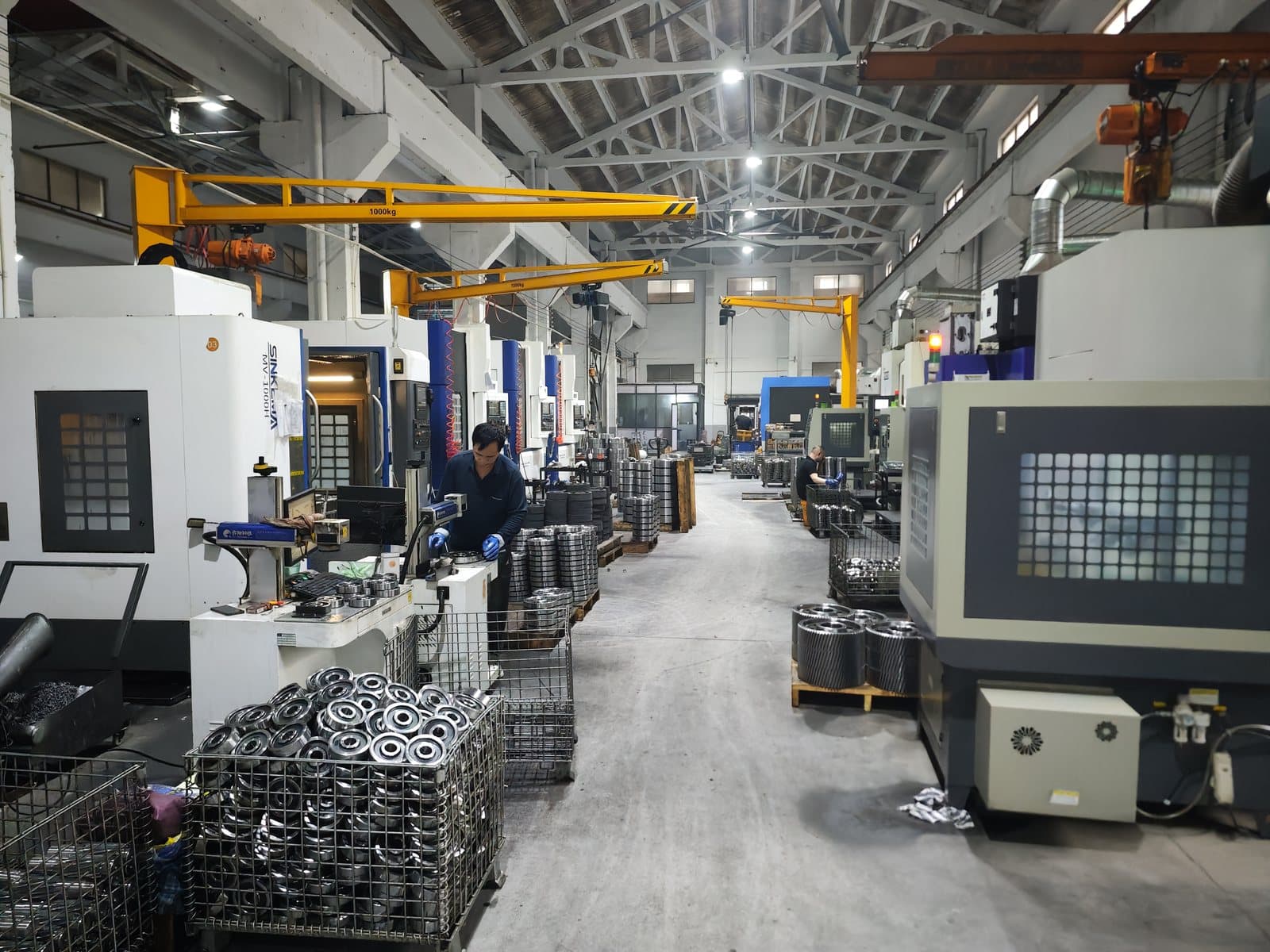
Gearbox overheating is one of the most common failure precursors. The good news is that the symptom pattern — steady-state temperature, time to reach it, and oil condition — narrows the root cause to a small set of possibilities before any disassembly.
What 'overheating' actually means
Every gearbox has a steady-state temperature rise above ambient at rated load. For typical R/F/K/S units, a steady-state rise of 50 to 70 °C above ambient at full load is normal; anything above 80 °C rise or any reading above 90 °C absolute casing temperature is a flag. Operating temperature, not temperature rise, is the binding constraint in most industrial environments because oil and bearing grease life halves roughly every 10 °C above 80 °C.
Read the symptom pattern
Three questions narrow the cause within minutes: How long does it take to reach steady state? Does the temperature climb continuously or stabilize? Is the overheating concentrated near one bearing housing or distributed across the whole casing?
- Steady state reached in 60 to 90 minutes with temperature rise of 50 to 70 °C: normal. No action needed.
- Steady state reached in 60 to 90 minutes but rise above 80 °C: typically overload or high ambient. Reduce load or improve ventilation.
- Continuous climb past 90 °C without stabilizing: oil starvation, failed bearing, or oil pump failure on forced-lube units. Stop the unit immediately.
- Hot spot at one bearing housing only: that bearing is failing. Replace before the damage propagates to the gear mesh.
- Whole casing hot, oil level correct, no abnormal load: ambient too high, ventilation inadequate, or wrong oil viscosity. Switch to a higher viscosity grade or add forced ventilation.
Common root causes ranked by frequency
- Overload or under-rated service factor: the most common cause. The gearbox is mechanically OK but thermally undersized. Step up one frame size or reduce the operating load.
- Low oil level or wrong oil grade: the second most common. Recheck oil level on a level, cool unit using the factory drawing for the actual mounting position. Many operators use the M1 oil-fill value at M3 or M5; this is incorrect.
- Blocked or fouled oil cooler on forced-lube units: cooling water or fan failure. Inspect and clean before further operation.
- Ambient temperature above 40 °C: standard ratings cover up to 40 °C. Above that, derate the continuous duty by 10 percent per 5 °C.
- Pre-mature bearing failure: hot spot at one housing indicates a specific bearing, not the system. Stop and replace.
What to record before calling the factory
Capture the steady-state casing temperature, the ambient temperature, the oil level (cold, on level surface), the oil condition (colour, smell, presence of water), the operating load versus the rated load, and any recent changes to duty cycle or environment. The factory support team can usually narrow the cause from these six items.
What to do right now
If the casing temperature exceeds 100 °C or you can smell burnt oil: stop the unit and let it cool. Do not run a hot gearbox to failure; the cost of a planned stop is a fraction of an unplanned failure. For persistent overheating that the standard checks do not resolve, send the symptom description, temperature log and operating history to sales@chinfar.com.