 ®
Technical guide
Industrial Gearbox Lubrication Guide: Oil Type, Fill Volume and Service Intervals
Author: HUIGUANG × CHENGFA Transmission Technical Team · Updated: 2026-09-19
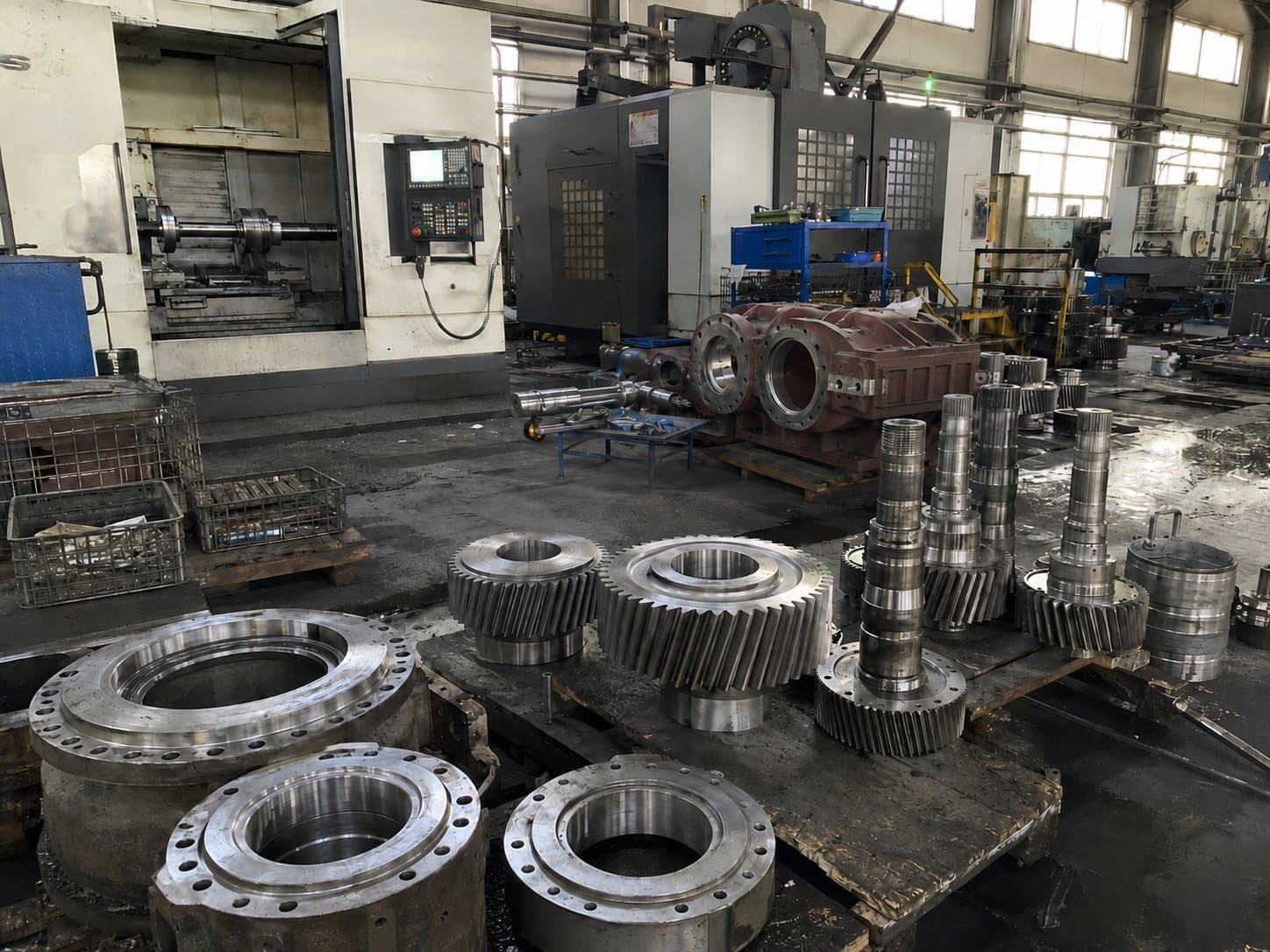
Lubrication is the single biggest determinant of gearbox service life. Gear-tooth pitting, bearing failure and seal leakage are nearly always preceded by a lubrication issue that could have been caught at the maintenance step rather than at the warranty claim.
What 'correct lubrication' means
Three independent decisions go into the lubrication specification. lubricant type (mineral, synthetic PAO, synthetic polyglycol, food-grade), viscosity grade (ISO VG 68, 100, 150, 220, 320, 460), and fill volume for the actual mounting position. Get any one of these wrong and the unit will not deliver its expected service life.
Lubricant type by family
For R/F/K series helical, parallel-shaft and bevel-helical units, mineral gear oil with EP (extreme pressure) additives is the default. ISO VG 220 covers most ambient conditions from -10 to +40 °C. For S series helical-worm units, polyglycol synthetic (PG) oils are preferred because of the worm gear's specific sliding friction profile. Food-grade applications use NSF H1 registered oils and seals throughout.
Viscosity grade by operating temperature
- ISO VG 68: very cold ambient (-20 to +10 °C) or very high shaft speeds (above 3000 rpm input).
- ISO VG 100: cold ambient (0 to +25 °C), normal shaft speeds.
- ISO VG 150: most common grade for general industrial duty (10 to +35 °C).
- ISO VG 220: warm ambient (20 to +40 °C), heavy loads, low shaft speeds.
- ISO VG 320 to 460: high ambient (above 40 °C), very heavy loads, continuous duty with thermal derating applied.
Fill volume by mounting position
Fill volume is not a fixed value per model. The sample data sheet lists oil quantities for M1 to M6 separately, and using the M1 value at M3 or M5 is one of the most common installation errors. For a typical K87 unit, M1 fill is around 2.5 L; M3 and M5 fills differ by 0.5 to 1.0 L depending on the breather and sight-glass relocation. Always confirm the exact fill from the factory-fitted drawing for the actual mounting position before commissioning.
Service intervals
- First oil change: after 500 operating hours or 3 months, whichever first. This removes assembly debris and break-in particles.
- Subsequent oil changes under normal duty: every 10,000 operating hours or 24 months.
- Continuous duty or high ambient (above 40 °C): every 5,000 operating hours or 12 months.
- Heavy shock load or dust exposure: every 3,000 operating hours or 6 months.
- Forced-circulation systems: change oil at 7,500 hours or 18 months; flush the cooler and replace the filter at the same interval.
What to record at every oil change
Date, hours since last change, oil drained (volume and condition), oil filled (type and volume), filter condition on forced-lube units, and any metal found on the drain magnet. A pattern of increasing metal on the drain magnet over consecutive changes is an early indicator of bearing wear; a single sample with a small amount of ferrous debris is normal for a unit past mid-life.
When the oil itself tells you something is wrong
Milky oil means water ingress — typically from a failed breather during a wash-down cycle or from condensation during long idle periods. Foil-coloured or smelling burnt means overheating, either from overfill or from a unit operating past its thermal rating. Either condition warrants immediate oil change and root-cause investigation, not just a top-up.
For lubricant selection support or project-specific viscosity recommendations, send the gearbox model, mounting position, ambient temperature range and duty cycle description to sales@chinfar.com.